
Your platform is either a tax or a multiplier

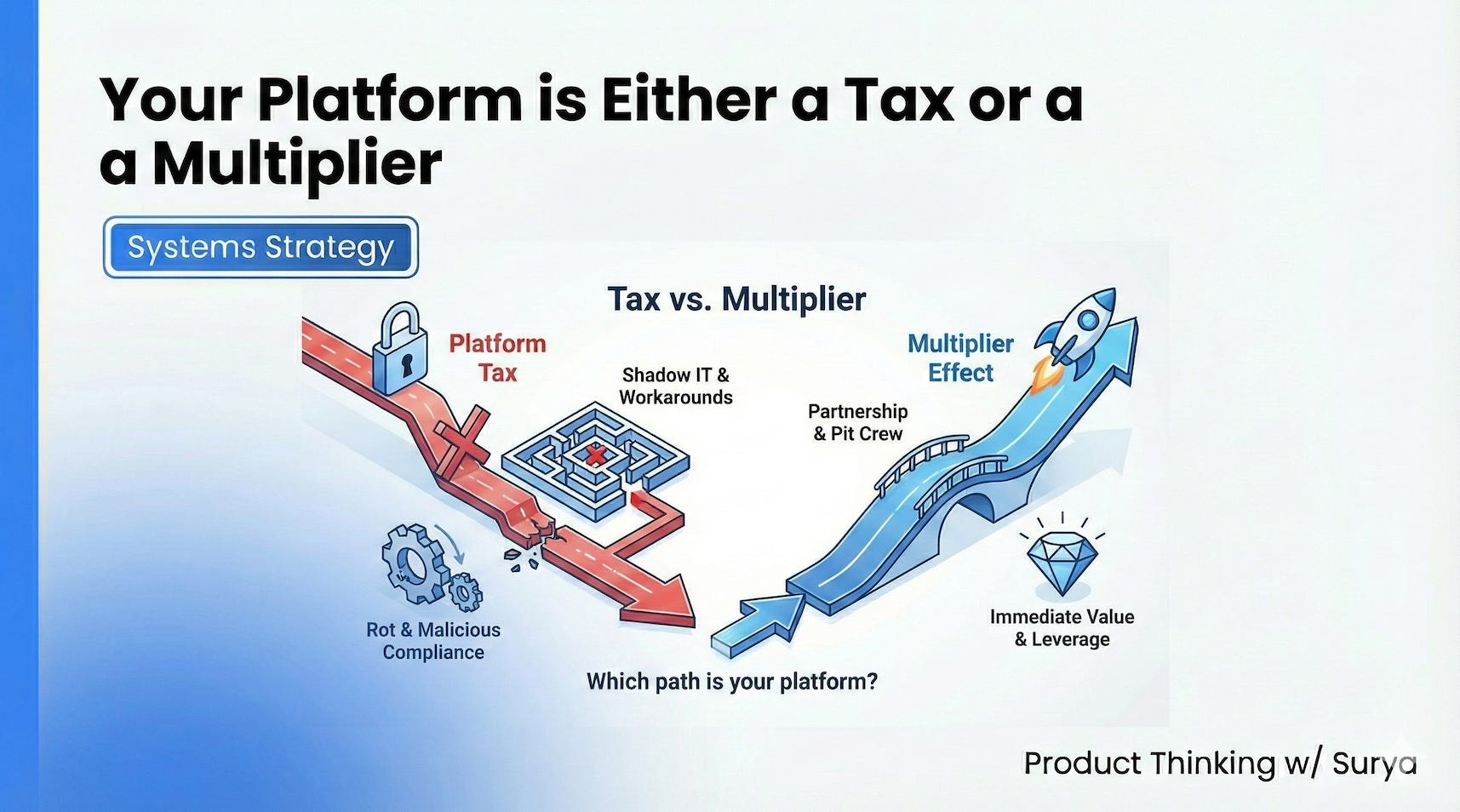
Internal product managers often believe a dangerous myth. They think they don’t have to worry about churn.
Since the company mandates the use of their API gateway, design system, or data warehouse, they assume their user base is guaranteed. They have a captive audience.
But in platform product management, users don’t churn. They rot.
When users are forced to use a tool they hate, they engage in malicious compliance. They do the bare minimum. They build “shadow IT” workarounds.
They complain to leadership until your budget gets cut. Every internal platform falls into one of two buckets: it is either a Tax or a Multiplier.
If you don’t know which one you are, you are probably a tax.
The platform tax
A tax is something you pay because you have to. In the context of a platform, it is a tool that slows users down in exchange for organizational compliance.
Your platform is a tax if it adds friction (“I have to file a ticket and wait three days just to get an API key”), requires distinct effort (“I have to rewrite my code to fit your rigid schema”), or delivers abstract value (the user feels the pain, the company gets the gain).
When you operate as a tax, your relationship with users is adversarial. You are the police. They are the citizens trying to avoid a ticket.
The multiplier effect
A multiplier gives users leverage. It abstracts away the boring, hard, or dangerous parts of development so product teams can skip infrastructure setup and go straight to feature development.
Your platform is a multiplier if it removes friction (“I dropped my code in, and the platform handled auth, logging, and scaling automatically”), accelerates velocity (“This saved me two weeks of integration work”), and delivers immediate value (the user feels the gain directly in their sprint velocity).
When you operate as a multiplier, your relationship with users is a partnership. You are the pit crew. They are the driver.
The mandate trap
The biggest enemy of the multiplier mindset is the corporate mandate.
When a CTO says, “Everyone must use Platform X,” the platform team stops selling. They stop treating their users like customers. They start treating them like subordinates.
This is where the product rot begins.
A “tax” team leans on the mandate to explain away their bad UX. They say things like, “They have to use it because of security compliance.”
A “multiplier” team ignores the mandate. They build a product so good that teams would voluntarily choose it even if they were allowed to use AWS directly.
Shifting from tax to multiplier
If you suspect you are building a tax, the shift starts with reframing your value proposition. You cannot just be a gatekeeper. The role shifts to gardener.
Sell the “boring” work. Don’t sell compliance. Sell the fact that you handle the tasks nobody wants to do. “You must use our library for security compliance” is a tax pitch. “You never have to worry about patching a security vulnerability again” is a multiplier pitch.
Measure time-to-hello-world. Tax teams measure uptime. Multiplier teams measure how fast a new user can ship value. If it takes three days to get onboarded, you are a tax. If it takes five minutes, you are a multiplier.
Compete with the open market. Assume your users can leave. If they could use Vercel, Stripe, or Auth0 instead of your internal tool, would they? If the answer is no, find out why. That gap is your roadmap.
The litmus test
There is one simple question to determine where you stand.
If the executive mandate were removed tomorrow, how many teams would keep using your platform?
If the answer is “nobody,” you are a tax. You are living on borrowed time.
If the answer is “most of them,” you are a multiplier. You are building leverage.
The choice is clear: gates or ramps. Most teams are still building gates.