
You Own the Build. Who Owns the Monetization?
Someone has to own whether a build becomes a business. Left unowned, it drifts. Here's how to give it an owner, without pressuring a customer.


The Short Version
Every product bet needs a defined success metric and a named owner. Revenue, or a strategic contribution that someone measures and puts a deadline on. Non-revenue goals are fine. Unnamed goals are not. The only real failure is drift.
What you’ll take away:
Why “go talk to growth” is technically true and still an evasion, and how to tell the two apart
Why faster AI build broke the traditional go-to-market handoff
A portfolio discipline that separates deliberate deferral from passive avoidance, without pressuring customers
“Because it is its purpose to create a customer, any business enterprise has two basic functions: marketing and innovation. Marketing and innovation produce results; all the rest are costs.” - Peter Drucker, The Practice of Management
“The single most important decision in evaluating a business is pricing power.” - Warren Buffett, Financial Crisis Inquiry Commission
The Neglected Half of the Business
Drucker named two functions in a business that actually create value: innovation and marketing. Everything else, he said, is cost. What he called marketing is close to what we now call go-to-market: understanding the customer, positioning, distribution, and above all monetization. More than seventy years later, most product organizations are excellent at innovation and treat go-to-market as someone else’s department.
Buffett reached the same neglected half from the other direction. Of every decision you make about a business, he said, pricing is the most important one. This piece is about that last one: monetization, and who owns it.
First, a clarification on scope. Plenty of what a company builds is not meant to be commercialized, and it shouldn’t be. Internal tools and experiments are meant to stay internal. The argument here is narrower: the slice of what gets built that could stand on its own, serve an external customer, carry a price, become a business.
That slice is growing, because building has never been faster or cheaper. A company now accumulates agents, tools, and prototypes faster than anyone catalogs them, and a real share of them could be products in their own right. Left unrecognized, each is simply cost in Drucker’s sense until someone decides it is a business. The potential is real, and mostly untapped.
Ask who owns whether one of them becomes a business, and often no one does. The build is treated as the finish line. Whether anyone will pay, and who is responsible for finding out, gets handed to a growth or sales team with little context on the product. This shows up consistently across companies, which points to a structural cause rather than a local one.
So the issue is not that everything should be monetized. It is that the decision to monetize, or to deliberately hold off, is usually no one’s. A decision that no one made, and no one will revisit, is not a strategy. It is drift.
The Neglect Is Well Documented
The pattern is old and measured. Simon-Kucher’s research, popularized by Madhavan Ramanujam in Monetizing Innovation, found that 72 percent of new products fail to meet their revenue or profit targets, or fail outright. Ramanujam traces it to one root cause: “the root of all innovation evil is the failure to put the customer’s willingness to pay for a new product at the very core of product design.” Pricing is the sharpest symptom, but the deeper failure is broader: no one decides how the product will capture value until after it is built.
Elena Verna describes the structural version. Many companies, she writes, still run an “outdated pirate framework where growth is divided into silos: Marketing handles acquisition, Product takes care of retention, and Sales is responsible for monetization.” Monetization ends up owned by the function furthest from the people building the product. That severed structure is the first of the forces below.
Often it is owned by no one in particular. In a McKinsey survey of 184 software executives, about three-quarters said they lack a dedicated, centralized function for pricing, relying on ad hoc approaches instead. If the most measurable piece of monetization has no clear home, the larger decision rarely does either.
What is new is the cost of getting it wrong. Bessemer’s 2026 AI pricing playbook notes that AI-native companies run 50 to 60 percent gross margins, against 80 to 90 percent for classic SaaS, because every query carries a real compute cost. Those margins are not thin, but they are lower than the SaaS baseline, and, more to the point, they are metered: cost scales with usage rather than sitting near zero. An un-owned monetization decision is no longer a harmless deferral; it is a recurring bill, charged every time the product runs.
So the problem is old, structural, and newly expensive. What gets less attention is why the drift happens, and how to fix it without simply moving the blame from one team to another.
The Forces Behind the Drift
The drift is not laziness. Underneath every force below sits one reflex: willingness to pay is the only signal a customer cannot fake, so it is the one people avoid. The same avoidance shows up three times over, first as instinct, then as excuse, then as organizational design.
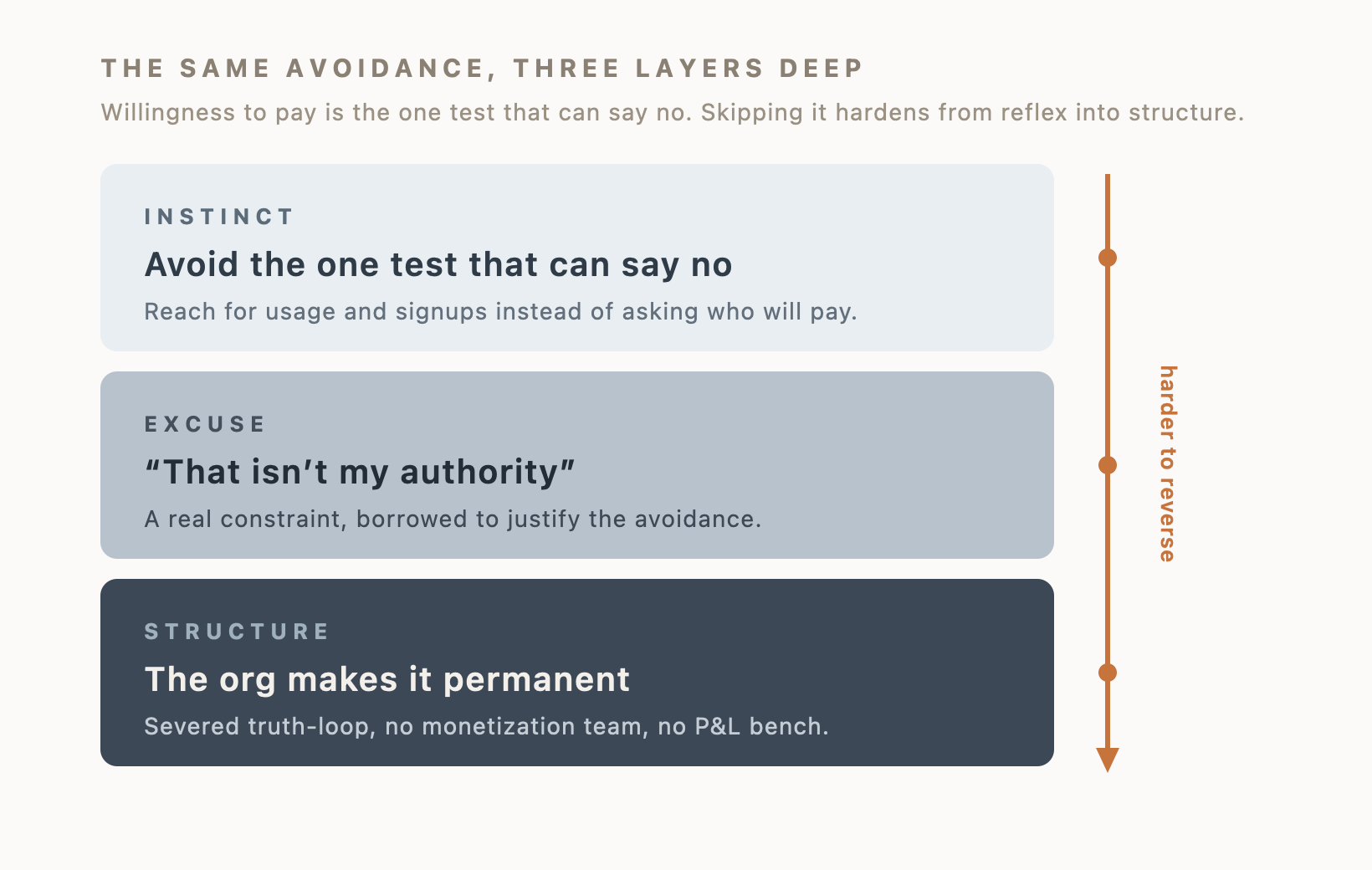
The instinct to avoid the one test that can say no
Sign-ups, active users, and stated interest can all be inflated by enthusiasm. Actual payment cannot. Because it is the only test that can come back negative, teams put it off and reach for the numbers that are easier to face.
The tell: a roadmap review that runs through usage, retention, and velocity, and never asks whether anyone will pay.
The excuse of missing authority
Product managers lead without formal authority as a matter of course, over engineering timelines, legal, budgets, and roadmap dependencies. Their role is built on influence, not power. Yet monetization is the one place many of them stop applying that influence. The authority gap is real, but here it serves as a convenient justification for an avoidance that was already there, the way “I’m empowering the team” can cover for a leader who has checked out.
The tell: “you’d have to ask growth,” about a product the growth team has never seen.
One clarification, before the obvious objection. Owning an outcome is not the same as doing the work: a product leader owns the outcome through influence and routes the execution to whoever is best at it. This is Marty Cagan’s “influence, not power,” not the product-manager-as-mini-CEO. No one is asking a PM to set the price, only to own whether the bet paid off, which is a matter of assigning ownership, not handing over authority.
The structure that makes avoidance permanent
Instinct and excuse would fade if the organization pushed back. Instead it has hardened them into structure, in three ways.
Proximity and authority sit in different rooms. When monetization moved into its own function, the two halves of one job split apart.
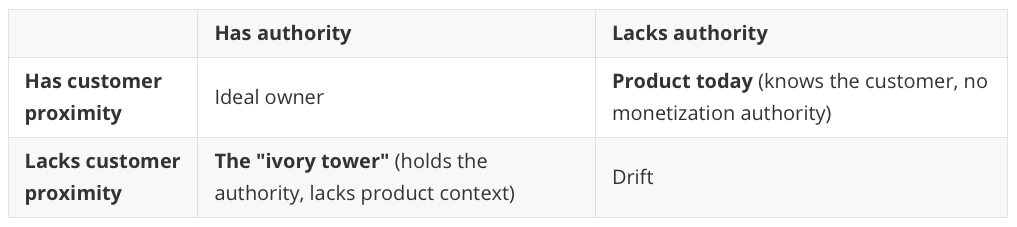
Product is close to the customer but holds no monetization authority. The function that holds the authority sits far from the product. Neither side can close the loop alone, and nothing forces them together before launch.
The tell: the price is set in a spreadsheet by someone who has never watched a customer use the product.
There is a team for building and none for monetizing. Companies standardized the build pod, product, engineering, design or data, and never created its monetization equivalent. For a decade, building was the bottleneck, so the organization was shaped around it. The bottleneck has moved; the structure has not.
The people were promoted for building, not for earning. Companies advanced product leaders on visible skills: shipping, craft, stakeholder management. Owning a number was rarely on the ladder, so few senior leaders ever built that judgment. AI widens the gap, because faster building rewards the build skills even more.
Each layer shields the one beneath it: instinct hides behind excuse, and excuse hardens into structure. That is why no single fix holds.
Why Faster Build Broke the Handoff
Those forces were survivable while building was slow. Speed removed the cover. The rising cost of getting it wrong is the visible half of the AI shift; the timing is the half that quietly breaks the operating model.
AI did not just make building cheaper. It made building fast, and go-to-market never sped up to match. Positioning, packaging, pricing, sales enablement, and pipeline take about as long as they always did.
For years, that mismatch stayed hidden, because a multi-month build gave go-to-market its lead time for free. Planning ran alongside the build, and a six-month build meant roughly six months of preparation by default. Go-to-market never needed a schedule of its own; it borrowed the build’s.
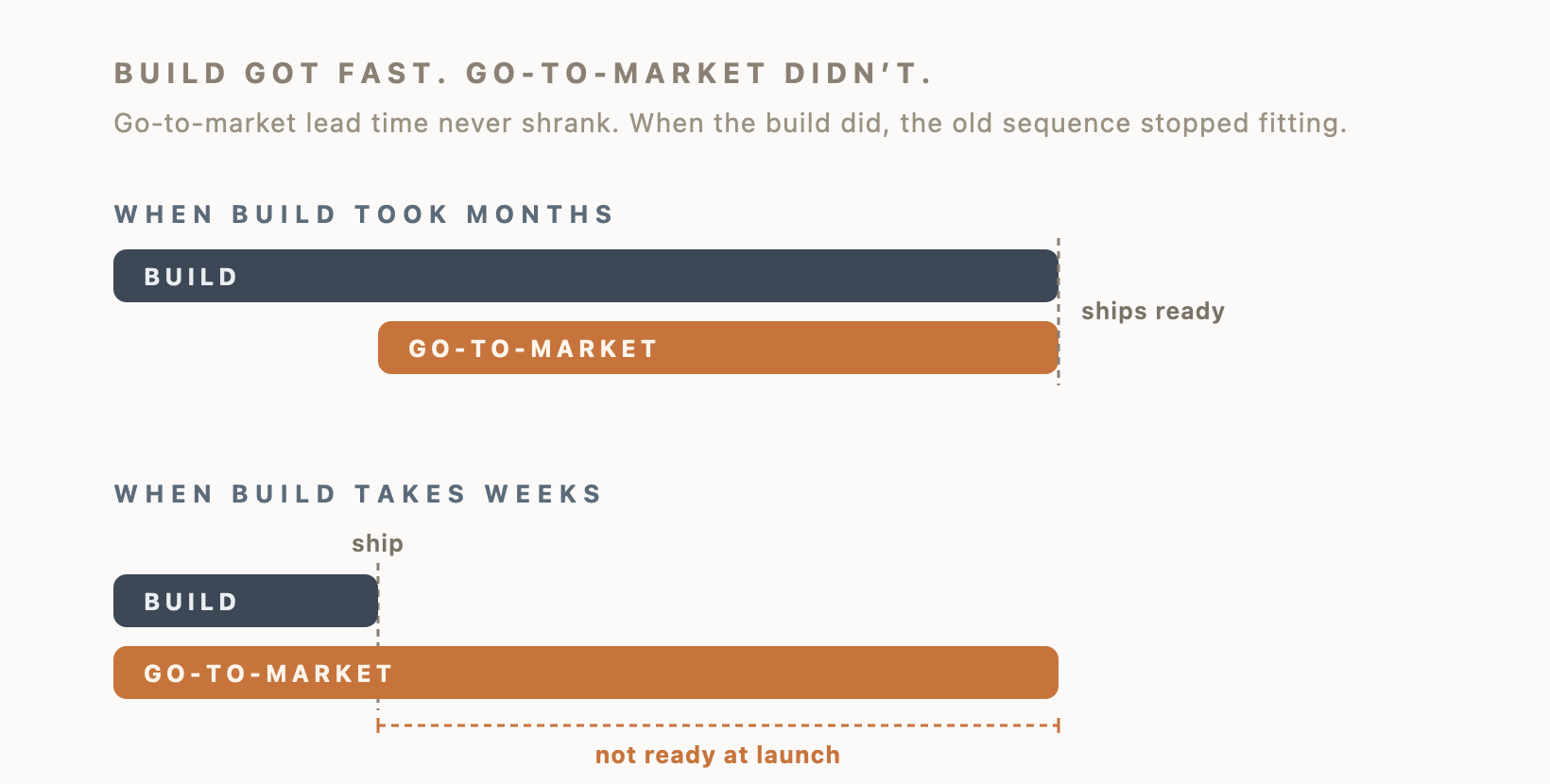
When the build collapses to weeks, that borrowed time disappears. The old sequence, build first and then hand off to sell, stops fitting: the product is ready before anything around it is. It ships with no price tested, no packaging, and no sales motion, so it either launches unmonetized or sits idle while the commercial work catches up.
Speed does something worse than compress each timeline. Shipping ten times faster means ten times as many products arriving at the same un-owned decision. The gap does not just tighten on each bet; it scales across all of them.
So go-to-market can no longer be a phase that follows the build. To be ready in time, it has to begin when the build does. That single requirement drives the fix.
Deferring Monetization Isn’t the Problem
Deferring monetization is often the right move. Driving adoption first and charging later built some of the most valuable software companies of the past fifteen years, and for a genuine land-grab it is the correct call. So slow monetization was never the problem. The problem is that deliberate deferral and passive avoidance look identical from the outside, and only one of them is a decision.
They pull apart on four questions:
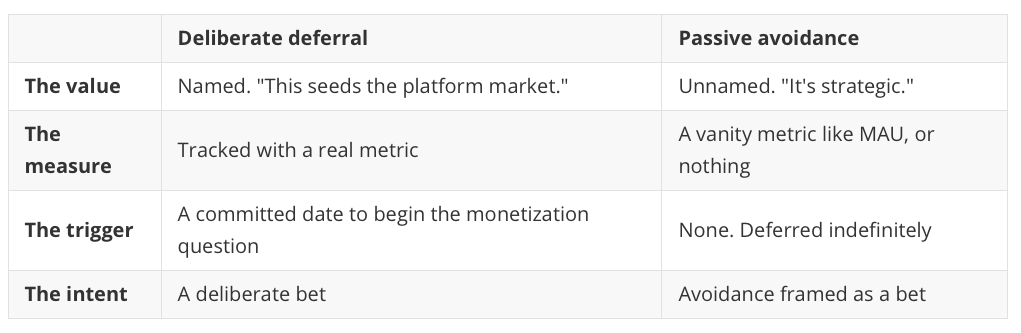
The visible behavior is identical; the intent behind it is the opposite. What separates a deliberate bet from avoidance is not the deferral, but whether someone named what it should achieve, attached a metric, and set a date to judge it. That is a test you can apply.
A second objection is sharper, and it comes from experienced operators. Separating monetization from product, they argue, is deliberate governance: you do not let the team that built something grade its own commercial homework. That is fair, and separation can work.
But it works only when the split keeps the loop intact, when whoever holds the authority stays close enough to the product to use it well, and someone stays accountable for the result. A monetization function that holds the lever without the context is not governance; it is the severed structure from earlier, and exactly how drift takes hold.
Stepping Back
The pattern is not confined to product teams. The same avoidance repeats at every altitude of the company, and each level reaches for a more respectable word than the one below it.
On the product team, it hides behind active-user counts.
In the portfolio review, it hides behind the word “strategic.”
In the board deck, it hides behind the growth story.
Each is the same evasion as the rung beneath it, and it gets harder to challenge the higher it rises. Nobody interrupts a board’s growth story to ask which of these bets will actually earn.
That is what makes the problem fractal, and what makes it stubborn. Because the avoidance recurs at every level, the discipline has to recur with it. A named metric and a deadline cannot sit at one altitude and go missing at the others; the test has to hold from the product team to the board. Making it hold is the work of the next section.
In Practice
The discipline that has to hold at every altitude is not complicated. Four moves for whoever owns the portfolio, and one for everyone else. None of them involve pressuring a customer; this is portfolio discipline, the way a business unit runs a portfolio.
1. Decide the success metric at the portfolio level. Someone with a portfolio-wide view, a CPO alongside a CRO or equivalent, names the success metric for each bet before it starts: revenue, or an explicitly named strategic contribution. Sorting which products are core revenue, which are growth bets, and which get deliberate monetization leniency is a deliberate call, made at the top. It also closes the split we saw earlier, putting authority and accountability at the level that can see every bet at once.
One limit is worth stating plainly. A portfolio’s “strategic contribution” and a single product’s revenue target can genuinely conflict, and putting them under one owner does not make the conflict disappear. What it does is surface the conflict at the start, when it is cheap to resolve, instead of at launch, when it is expensive. That is a smaller claim than full alignment, but it is the honest one.
2. Hold every non-revenue goal to the same bar as revenue. Otherwise “drives ecosystem adoption” is just a vaguer vanity metric. Name it, measure it, and time-box it: a specific contribution, a metric you actually track, and a date by which it must show results or convert. A goal that fails any of the three is not being deferred; it is being avoided.
3. Give the monetization question an owner before the build begins. Go-to-market can no longer follow the build, so it has to start with it. One commercially minded person is enough; a full sales team this early would be premature. They carry the monetization and willingness-to-pay question from the moment the product hypothesis is formed, because there is no runway to add the role later.
4. Run monetization as a hypothesis, and review it like one. Give the monetization question its own hypothesis and review date, in parallel with the product hypotheses rather than downstream of them. Then actually look at the results, including the bets that failed, because a failure no one examines costs twice: once to build it, and again because no one learned from it. In a portfolio, some bets are supposed to fail; the discipline is in learning from them.
And if you do not own the portfolio? Most readers will not. The authority to set these terms may sit above you. The ownership of the question does not.
Name the willingness-to-pay hypothesis for your own bet before anyone asks. Bring the monetization question to the review unprompted. Neither requires permission.
And if your organization documents its bets, read them: what was tried, what worked, what did not. Much of it is contextual, and you will not reconstruct the full picture behind each call. Study them anyway, because a library of real cases is how you build the commercial judgment the ladder never taught. You cannot vote yourself the authority, but you can be the person who always asks the question, and who has seen enough to ask it well.
The Only Real Failure Is Drift
None of this requires monetizing everything, or treating a strategic loss leader as a failure.
What it condemns is narrower: the unowned, unnamed default. The bet that got lenient treatment because no one chose to be lenient, and that will never be reviewed. Ask who owns the monetization, and the honest answer is no one. It is un-owned.
Drucker set marketing beside innovation and called everything else cost. In the years since, building became the half we celebrate and earning the half we defer. But the second function was never optional, and a product whose monetization has no owner is precisely the cost he named, running quietly in the background.
The remedy is not heavy: a named metric, a date, an owner from the start. Against that, drift is just what you get for free, and it compounds.
You can defend deferral, a loss leader, even years of free access before a dollar of revenue. What you cannot defend is drift. And drift ends the moment someone owns the question.