
Run Your AI Transformation Like a Product
A product leader's guide to the four jobs AI transforms differently, and the one it quietly erodes.

AI collapses the cost of everything except the irreducible job of product management: sensing real problems, judging what is worth building, shaping the solution, and aligning the org behind it. Transformation is not adopting AI. It is using that cost collapse to re-close the distance to those four levers, while protecting the ones it erodes.
Why tool adoption produces almost no value, and why that is an organizational problem.
A first-principles model that tells you where AI is a gift, where it is neutral, and where it is destructive.
The working tools: a two-faces test, a wallet gate, a portfolio grid, a drift diagnostic, three replacement numbers, and the order to run them in.

The report that looks like progress
The slide in the quarterly review says ninety percent tool adoption, a dozen AI pilots in flight, engineering velocity up. Everyone nods. The number that does not appear on the slide is the one that matters: what changed for a customer, and what changed in the P&L.
If you have sat in enough of these rooms, you know the tell: the energy tracks the adoption number, not any customer outcome. Someone eventually asks what changed for the people who pay us, and the room treats it as an interruption. I have watched that moment for two decades, and only the logo on the slide changes.
The agile wave measured ceremonies adopted. The cloud wave measured workloads migrated. The slide survives every technology because it was never about the technology.
The macro picture matches the slide: roughly 88% of organizations now use AI in at least one function, yet only around 6% capture meaningful value (McKinsey, State of AI 2025).
The reflex is to read this as a technology problem. The failures are organizational: judgment about where to point the technology in the first place.
Most of those organizations pointed AI at the system that already made them successful and made it more efficient, which shows up as adoption.
But value is moving to a different way of working, not a faster version of the old one. The teams capturing value are not the fastest adopters; they are operating on a different model, which the rest of this piece is about.
First principles: what product management actually is
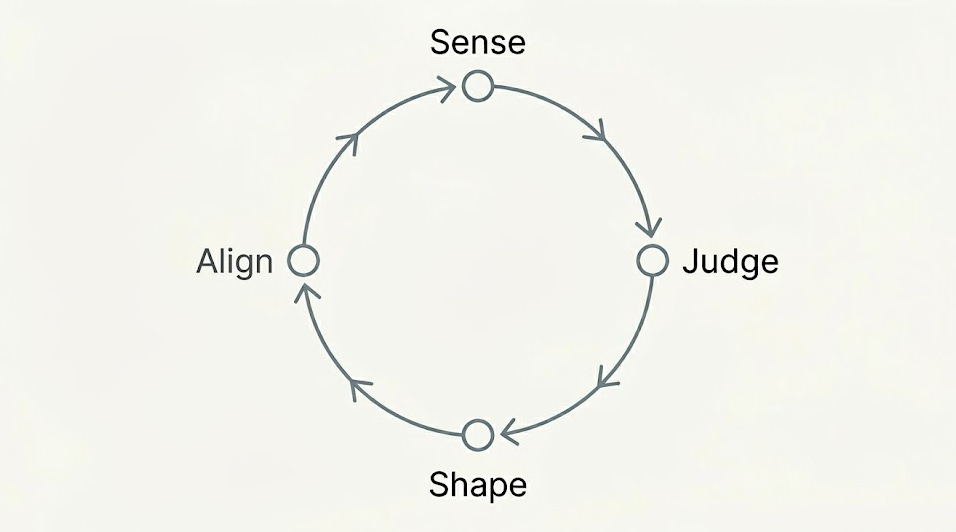
Strip away the artifacts. No roadmaps, no ceremonies, no titles. The irreducible job of product management is a loop of four moves.
Sense the problem closely enough to understand it.
Judge what is worth building under uncertainty.
Shape a solution and validate it.
Align the org to commit and execute.
This is a lens, not a metaphysical claim, and it earns its place because it predicts where AI helps and where it hurts. Everything else a product team does is scaffolding around these four, and AI has just collapsed the cost of scaffolding to near zero.
So transformation is not “add AI.” It is re-deciding which scaffolding to keep now that it is free, one lever at a time.
Lens 1: Every lever has two faces
Each of the four levers has a mechanical face that AI eats, and a human face that AI exposes.
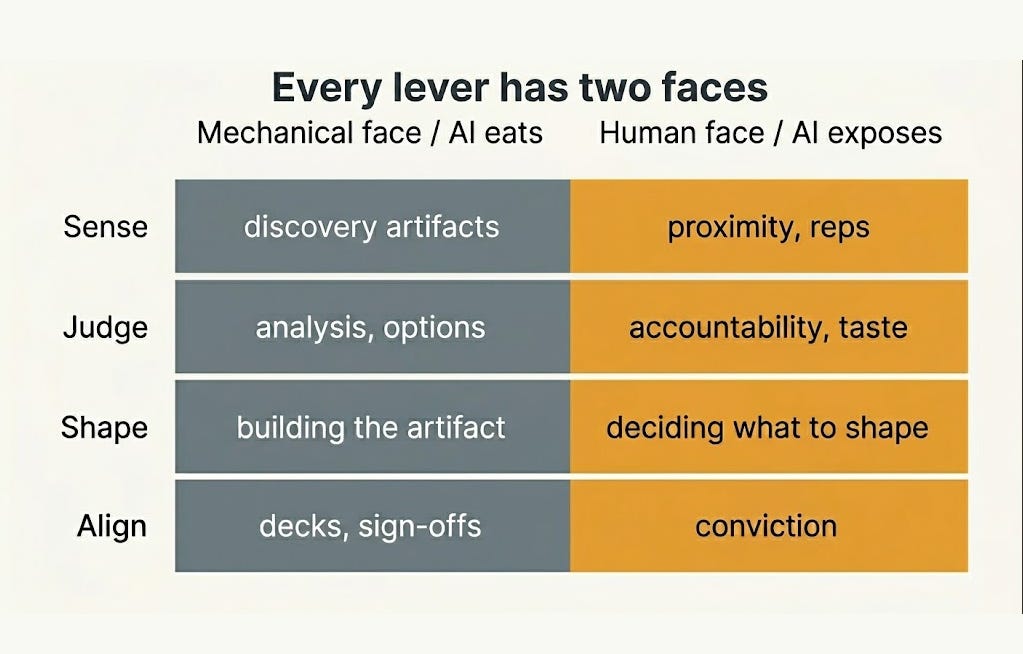
Gift or danger depends on one question: did the human face depend on the mechanical one?
For Align, the answer is no. Decks and status meetings never built conviction. Stripping them is mostly free. That is the clean gift.
Shape is close behind: building the artifact was never where the judgment about what to shape lived. What changes is who builds, which gets its own section below.
For Sense, the answer is yes, and it is what most transformation plans get wrong. The “busywork” of discovery production, the customer calls you are tempted to automate, was the training ground where judgment got built. Automate the production and you keep the output while quietly removing the reps, producing an org that looks more efficient and gets steadily worse at knowing what to build.
The strongest objection lands here. AI-moderated interviews, synthetic users, and automated ticket synthesis produce real signal at a scale no PM calendar can match. But the trouble is structural: these tools sense what is already legible, the articulated complaint, the ticketed bug, the behavior in the logs. The problems worth a company’s next bet usually live in what customers cannot articulate yet, and the only known instrument for that is a human who was in the room.
This is why “automate everything” and “preserve all friction” are both wrong. The cut is per face: strip the mechanical face where it is decoupled from the human face; protect it where it is the reps that build judgment.
On Judge, a clarification for anyone who has watched AI write a credible strategy memo. The claim is not that AI cannot reason; it informs judgment well. What stays human is accountability for the bet and taste under genuine uncertainty, plus the reps that build both; outsource the reps and the taste atrophies at exactly the wrong moment (see the Judgment Layer series).
Lens 2: Who opens their wallet
A second blindness runs under all four levers, and it is the most common one I see. Teams run the entire loop on the value they create and stay blind to the value they capture: sense a problem, judge it worth building, shape it, ship it, and only then ask someone to talk to growth about monetization. Treating capture as a final stage is the disease.
The capture question belongs in every lever. Whose budget, not just whose problem; worth building means someone pays, not just clicks. Does the design preserve willingness to pay. Align on the business model, not the demo.
AI makes this worse. Build cost was a quiet commercial filter: scarcity nudged you toward the things someone would pay for. With the filter gone, capture-blind teams ship value-less features faster than ever, faster at building the wrong thing, where “wrong” now includes “commercially worthless.”
So install the wallet question as an explicit upstream gate, because the implicit one is gone.
Lens 3: What you build, not just how you work
Everything so far is about the operating model. But AI is two things at once: a tool that makes existing work cheaper, and a capability that makes new products possible. Pointed inward, it is efficiency. Pointed at the portfolio, it is reinvention.
Most transformation programs run only the first and call it done: the trap from the opening, one altitude up. The harder move is to ask what the team is now allowed to build, given that the cost frontier and the capability frontier both moved at once.
So the portfolio splits, and the split is the work. Some segments stay untouched on purpose: the cash cows, the compliance-bound, the parts carrying too much of the business to risk. Some are ripe for reinvention, where AI’s new capability changes what the product could be, not just how fast you ship it. The leader’s job is to know which is which, and to resist reinventing the cash cow or efficiency-optimizing the thing that needs a rebuild.
Here the wallet question stops being per-bet and becomes the sorting function. A product can be loved and capture nothing, because capture depends on the structure of the business and the assets behind it, not the quality of the work. When build cost goes to zero for everyone, “we built it” is no reason anyone opens a wallet.
The only durable reason is something the same tooling does not hand your competitor, and it takes two forms: a unique asset AI multiplies rather than commoditizes (proprietary data, customer relationships, distribution, hard-won functionality), or a business-model position an incumbent cannot copy without cannibalizing the business that funds it. Either survives the cost collapse. A feature does not.
This is why AI is a multiplier, not a disruptor. It does not reset the board from outside the way PC or mobile did; it multiplies whatever is uniquely yours and commoditizes everything that is not. The threat is never AI itself, it is a competitor with the same models matching what was never really unique about you.
That gives the portfolio two axes, and the grid is the allocation tool.
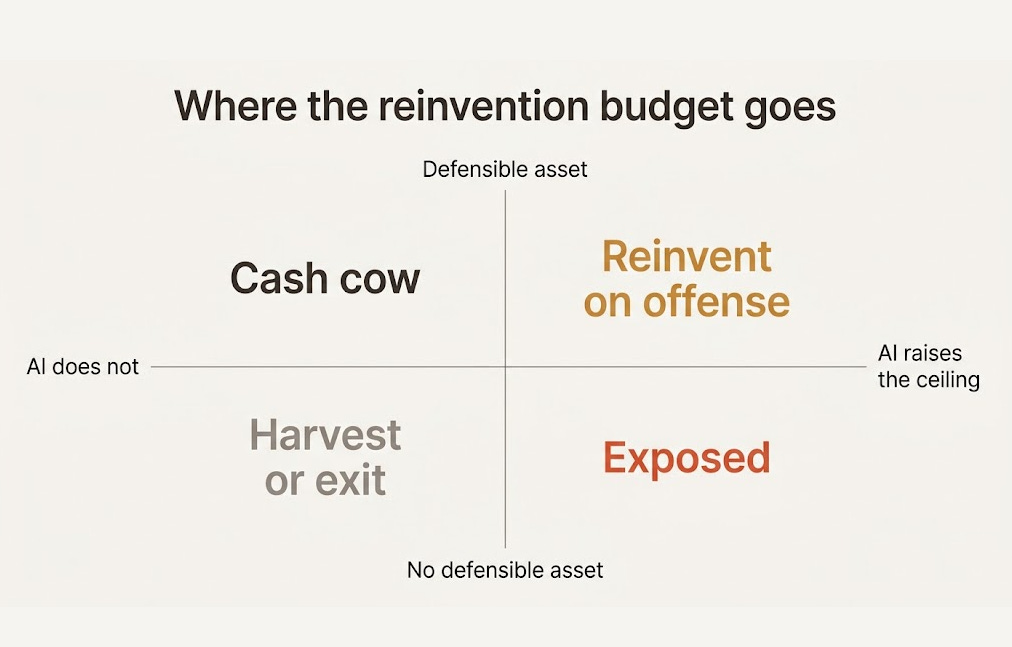
The corners have public receipts. Chegg sat exposed: nothing the same models could not match, and ChatGPT matched it. GitHub sat across the asset line and multiplied its place in every developer’s workflow into Copilot.
The wallet test tells you whether one bet captures value. The grid tells you where to spend the reinvention budget at all: which segments earn the real prototypes and your strongest people, the two things that stay scarce.
The grid also reweights the levers per cell. In the exposed quadrant, Judge is mostly what not to build; in a reinvention bet, Sense re-runs from scratch, because your accumulated intuition was calibrated to the old ceiling.
Lens 4: Friction is directional
Most transformation advice fails because it prescribes one direction for everyone, “move faster” or “add rigor.” The right prescription depends on which lever a given team has already starved, and the unit is the team, not the company: a great leader inside a large company can carve out a pocket that operates like a fifteen-person startup.
Read the drift, then aim AI at the gap rather than the gift. Five rows for four levers, because Align fails in two directions: coordination bloat, or conviction drain.
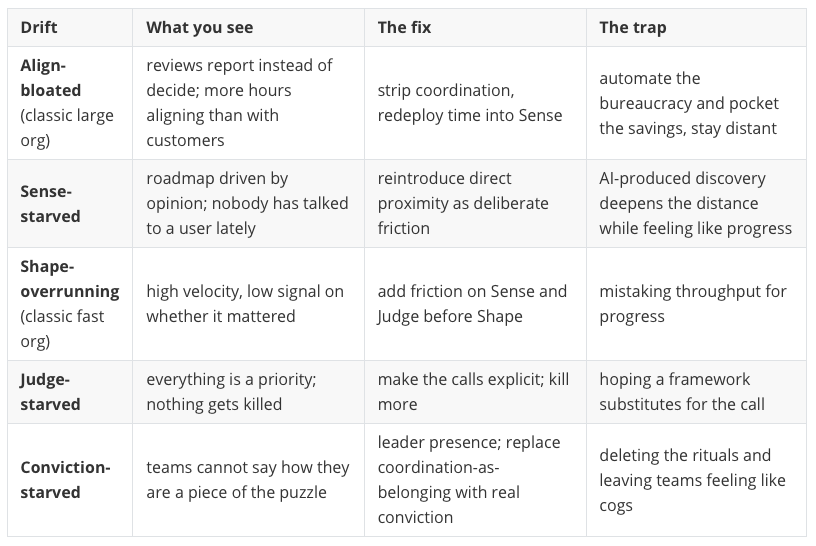
One row, run end to end. A team I will keep vague: B2B product, strong velocity, discovery fully tooled. Every roadmap item arrived with an AI-synthesized research pack, and nobody on the team had sat with a customer in two quarters. Discovery output was up, and proximity was gone.
The tempting fix was more rigor on the packs. The actual fix was deliberate friction: every PM back in front of customers, five live sessions a month, tracked in the review that used to celebrate the packs. The grumbling was that the sessions were slower than the synthesis.
They were. That was the point. By the second quarter the team killed a roadmap item the packs had ranked near the top, because three customers in a row described the problem in the language of a workaround the synthesis had averaged away. The kill was the proof: a decision traceable to neither a dashboard nor a deck.
A large org will show mixed signatures across teams. That is where the pocket, or enclave, comes in: a team given cover to operate at first principles on a real stack while the larger org grinds.
Enclaves fail in predictable ways: resentment, reabsorption, a two-tier org. The antidote is to treat the enclave as a sequence, not a special project: win one place completely and use the win as the bridge to the next. The favoritism objection answers itself, because the cover the enclave earns is what the next team inherits.
Everyone is a builder now
The product people who come through this have done two things: mastered the four levers, and made themselves technical enough to build. The best PMs I know are not writing more specs; they are writing code.
Technical enough does not mean production-deep. It means real enough to build a prototype, refine it the next day, and bring it to review as something people react to as behavior, not pixels. On the production stack where feasible; in gnarly enterprise environments it often is not, one more reason the enclave matters.
A stack-real prototype is a Shape artifact that feeds all four levers.
Real reactions sharpen Sense.
Real signal sharpens Judge.
A real thing to rally around accelerates Align.
Building real things fast is the skill that compounds.
The guardrail: a prototype amplifies whatever judgment sits behind it. Built on a starved Sense, it produces a faster and more convincing wrong thing, because now it looks real. The technical bar and the judgment bar have to rise together.
Marty Cagan has argued a version of this for years: the PM whose job was really project coordination is the one AI replaces, and the bar for everyone else goes up. Expect fewer product people per surface, each closer to the customer and the code.
The career ladder needs the same rebuild, because its middle rungs were mechanical: run the process, produce the artifacts, coordinate the launch. Progression has to re-anchor on the reps that still matter: proximity hours, calls owned, things built and reacted to. The hiring profile follows: appetite for the customer and fluency with the tools, over artifact polish.
Stepping back: why the standard transformation fails
The dominant approach treats AI as a uniform efficiency upgrade. Roll out the tools, measure adoption, count the pilots. That approach accelerates the two levers that were never your bottleneck (Shape and Align coordination) and erodes the one that usually was (Sense).
“Adopt AI” is a goal, not a strategy: a real strategy starts with a diagnosis of what is in the way, makes a guiding choice, then commits to actions that fit. Ninety percent adoption diagnoses nothing. It is an aspiration in the costume of a plan.
None of this makes the tools optional. Near-universal fluency is the substrate; adoption is the floor you stand on, not the scoreboard you read.
The deeper error is managing transformation by the wrong instrument. Adoption is the mechanical face of a leader’s own sensing. It is cheap to measure and it lies. Value and ROI are lagging indicators of a capability that, by the time the number moves, is already gone.
A product leader is running the same four levers one altitude up: sensing the org’s drift, judging where to point AI and what to stop, shaping the operating model, and aligning the org, peers included. The transformation is a product, and it deserves the same first-principles discipline as any other.
The order of operations
The five lenses are a kit, not a sequence; the sequence falls out of the dependencies.
Sort the portfolio first. There is no point repairing a team’s drift on a segment you should be harvesting.
Diagnose drift second, team by team, because the prescription is directional. Only then pick the enclave, and pick it where the two answers intersect: a segment the grid marks for reinvention, held by a team you can give real cover. Most leaders choose the enclave by enthusiasm; the intersection makes it a strategy rather than a pet project.
Two moves are exempt. The wallet gate and the leading signals are cadence changes, not reorganizations; install them now. The talent calls come last: the same judgment you just made about segments and teams, applied to people.
In practice
In your reviews
Diagnose drift per team. In the next set of reviews, ask which lever this team has starved. Is the meeting reporting or deciding, when did someone last sit with a customer, what got killed this quarter, and can the team say, unprompted, how their work carries the vision.
Install the wallet test upstream. For every significant bet, require an answer before build, not after: if this works, who still opens their wallet, and why. Make it a gate in Judge, owned by the team.
Replace the adoption slide with three numbers, the fifth lens. Live customer sessions per PM per month, reviewed in the forum that used to celebrate adoption. Kills per quarter, named, with the reason attached. The share of significant bets that had a written wallet answer before build started.
These are gameable too; every number is. The check is whether decisions trace to them: a kill that cites a session, a redirect that cites a wallet answer. Conviction stays off the slide on purpose; it does not compress to a number, and the drift diagnostic already gives you the words.
In your talent cycle
Invest concentrated, and be honest about the cut. A generational shift makes part of a workforce redundant, and the layer is larger this time because AI eats the mechanical face of every lever at once. The redundant layer is not defined by seniority; it is the people whose value was primarily mechanical, at any level. Name that plainly, invest heavily in the people who keep a premium on their craft, and treat cutting without reinvesting as pocketing the savings.
You have met both of these people. One is senior, fluent in the rituals, and has not sat with a customer or made a hard call in years; the title says premium, but the work went mechanical long ago. The other is two years in, living inside the problem, building something real enough by Friday to change what the team thought it knew. The signal is never the level on the org chart; it is whether the person still does the reps the machine cannot do for them.
With your peers and the board
Take a different slide upstairs. The adoption number from the opening exists because it fits the slot the board offers: where are we on AI, ninety percent, next item. Changing your teams’ instruments while leaving the board’s slot unchanged recreates the theater one level up.
So fill it differently. Bring the three numbers, the grid with the segments you will not reinvent and why, and the kill log as the receipt for deliberate slowness. When the mandate arrives as adopt-AI-by-Q3, the order of operations is the counter-offer: a diagnosis and a sequence in place of an aspiration. When the cost collapse shows up in the CFO’s model as headcount savings, have the reinvestment fraction already decided, because pocketing all of it is the align-bloated trap run by finance.
Do not go to war with your peers. When building gets cheap, the lines between product, engineering, design, and growth blur, and every leader fights to own the transformation or shield their team. Most organizational damage in a transformation is done with good intentions. Define ownership by outcome, not territory; the competitor is the enemy, not the leader across the table.
The posture for this moment
The leader this moment rewards is neither selling the hype nor hiding from it.
They are honest that a real layer of work is gone, and generous in investing where it counts. They strip the mechanical face where it is dead weight, and protect it where it was secretly building judgment. They run all four levers on the transformation itself, with both faces lit, while everyone else automates the scaffolding and calls it strategy.
AI did not change what product management is. It removed the cost that was hiding whether you were doing it.