
Building to Think in the Full-Stack Builder Era

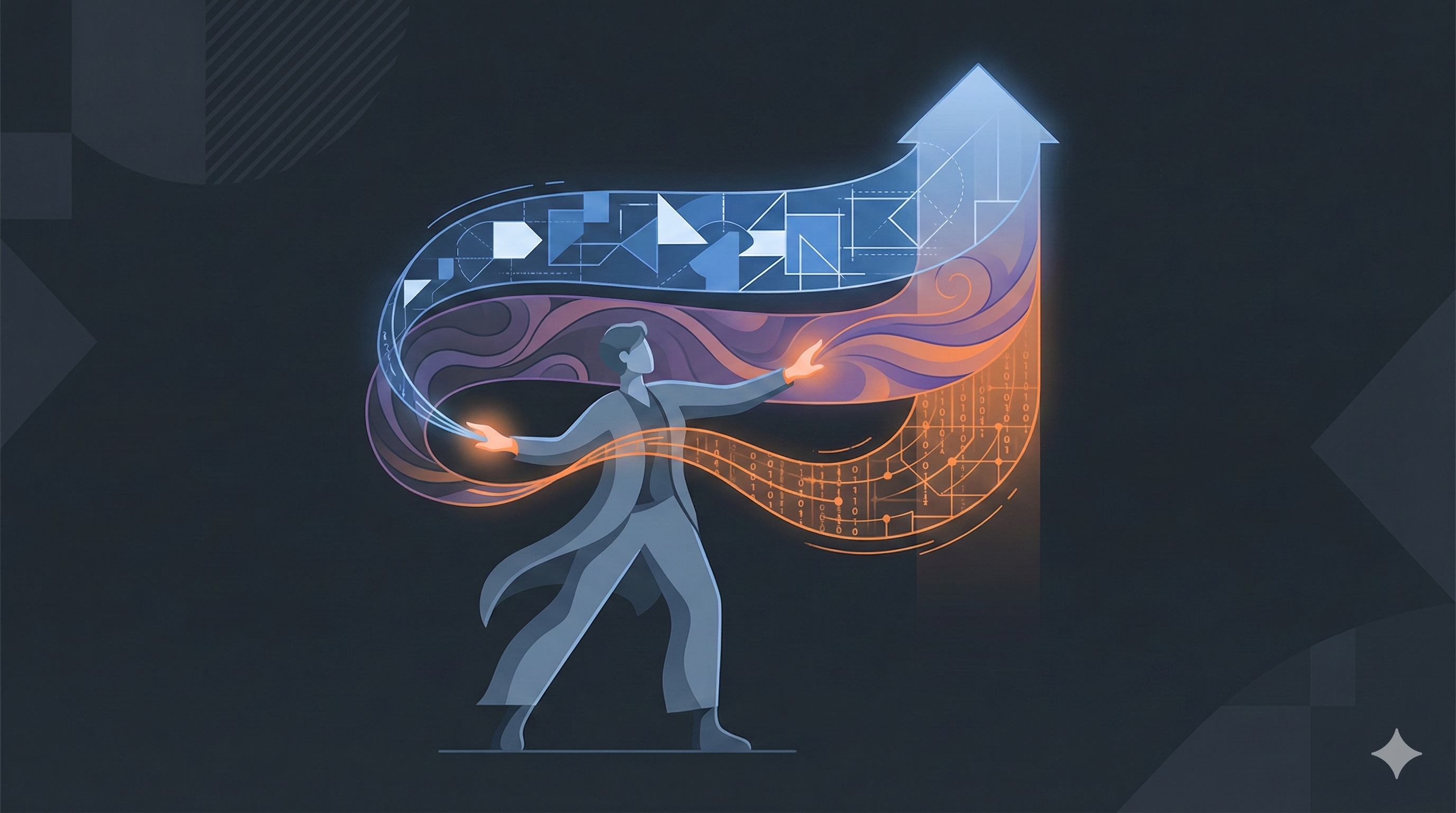
The debate over the future of product management has been polarized. On one side, the “PM is Dead” crowd argues that AI automates the coordination layer, making the role obsolete. On the other hand, the “Tech-PM” advocates insist the role is simply shifting closer to the code.
Recently, LinkedIn picked a side. In a conversation with Lenny Rachitsky, LinkedIn’s CPO, detailed how they restructured their Associate Product Manager program (traditional product management training) and replaced it with the “Associate Product Builder” program. Their new mandate? Full-Stack Builders, while acknowledging that the specialists have a vital role to play. Not mutually exclusive, but there’s a trend building.
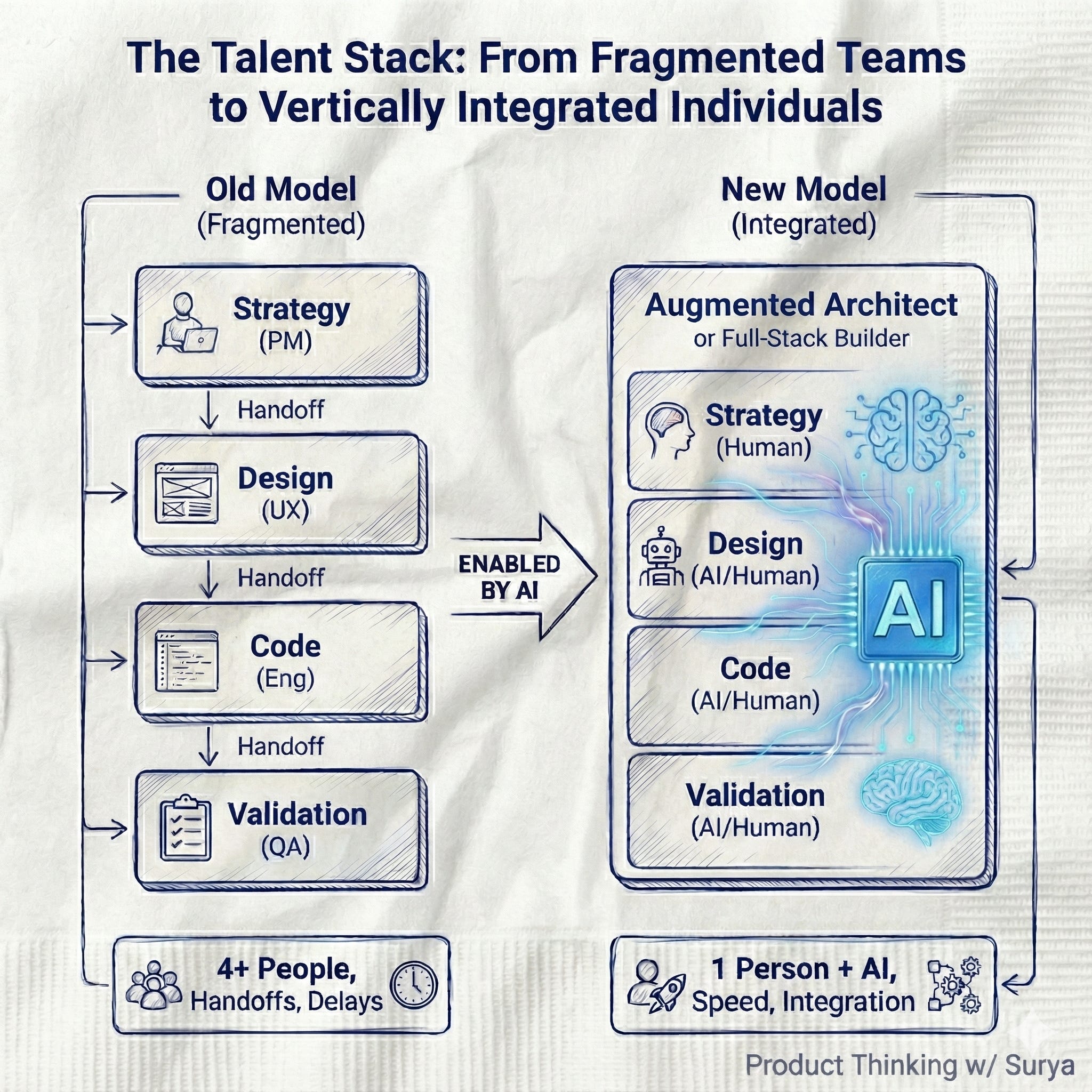
This isn’t just another tech company tweaking job titles; it is a signal that the market has moved. The era of the “Product Trio” (where a PM writes requirements, a designer draws mocks, and an engineer writes code) is buckling under its own inefficiency. In its place, we are seeing the rise of the Augmented Architect: a single operator who leverages AI to vertically integrate strategy, design, and execution.
This shift validates a harder truth: the administrative layer of product management is dying. The traffic cop who manages handoffs is being automated away. What survives is the Builder: someone who uses AI not just to speed up, but to reclaim the full creative stack.
Here’s what’s ahead:
Why the Product Trio model collapsed under its own latency
How LinkedIn built infrastructure to enable Full-Stack Builders at scale
What “Building to Think” means and why it’s not the “jack of all trades” trap
The three investments required to make this work in your organization
Why the trio is breaking down
The “Product Trio” (PM, Design, Engineering) wasn’t a mistake; it was a necessity. The complexity of the stack demanded hyper-specialization. One person couldn't master strategy, sophisticated UI systems, and distributed backend architecture simultaneously. Splitting the brain was the only way to scale.
For a decade or so, it worked. But it came with a hidden tax: Latency.
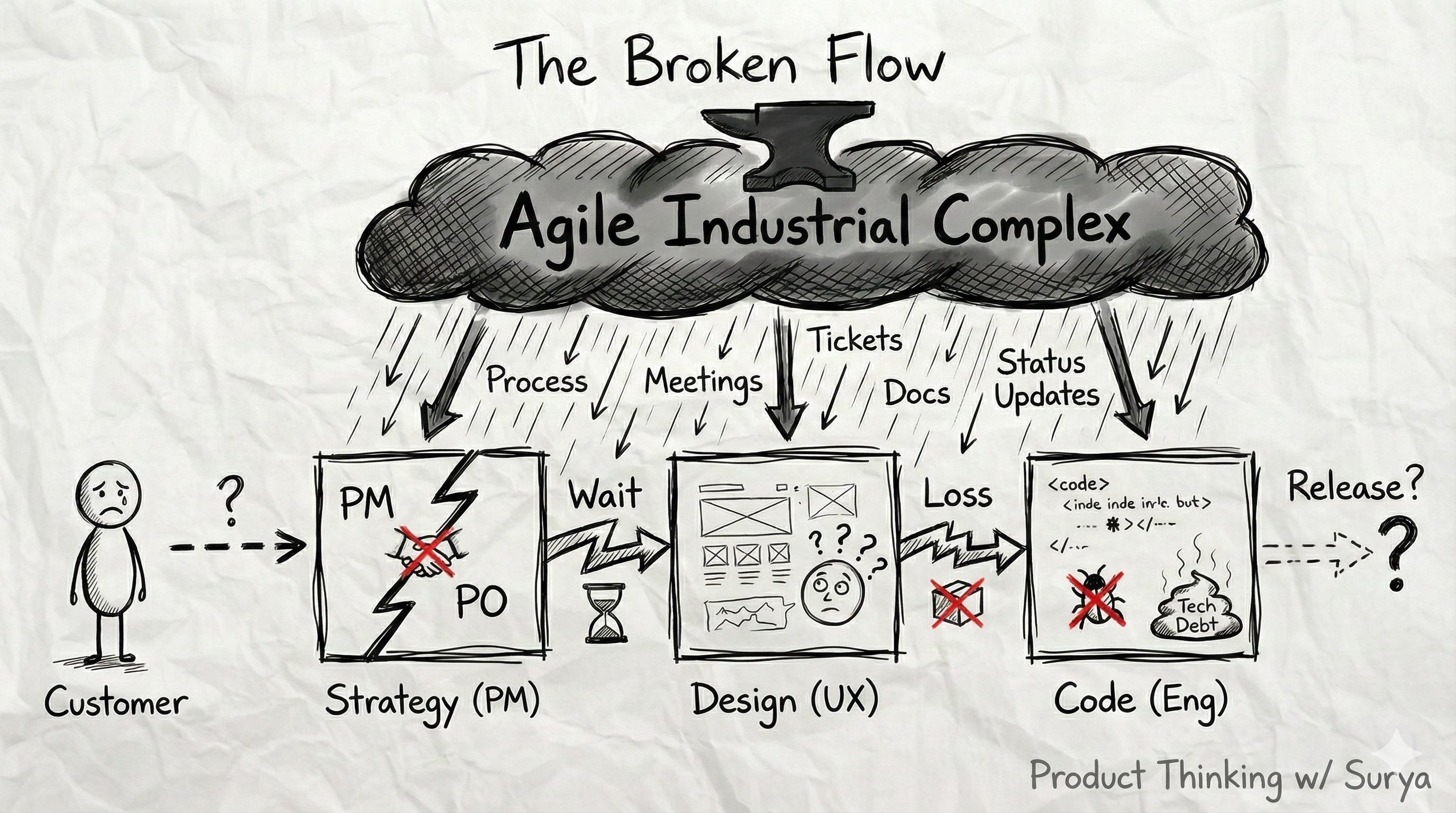
We built a supply chain of talent. The PM defines the ‘Why,’ Design defines ‘What’ it looks like, and Engineering defines ‘How’ to build it. Every handoff creates a delay, and every delay creates a leak. Context is lost when a strategy deck becomes a wireframe. Nuance evaporates when a wireframe becomes a Jira ticket.
To patch these leaks, we built an entire ecosystem of coordination. Far removed from the original Agile Manifesto, we invented the Agile Industrial Complex: a bloat of standups, retro rituals, and endless syncs.
...creating an artificial divide between the Product Manager (Strategy) and the Product Owner (Backlog). Now, we didn’t just have handoffs between functions; we had handoffs within the brain of the product leader.
This created a management nightmare. Entire career paths in Program Management emerged just to coordinate the coordinators.
Today, many Product Managers spend 70% of their week servicing this complex. They aren’t building products; they are managing the friction of the process.
The tragedy is what gets displaced. When a PM is drowning in ticket grooming and alignment meetings, the first thing to go is the customer. Ask a modern product team, “How many customers did you talk to this month?” and don’t be shocked when the answer is single digits, or zero. The system designed to build products has cannibalized the time needed to understand who they are for.
This latency tax was acceptable when the alternative was not building at all. But today, when AI can generate a functional prototype in 60 seconds, the calculus has shifted.
Building to think
When some industry voices warn against the “Full-Stack PM,” their argument is familiar: “Don’t be a jack of all trades and master of none.” They fear that asking a PM to code or design will dilute their focus on the customer.
This fear is rooted in an obsolete definition of “building.”
The goal of the Augmented Architect isn’t to replace the Senior React Engineer or the Principal Product Designer. You aren’t building production code to save money on headcount. You are Building to Think.
We need to distinguish between mastery and fluency.
Mastery is your deep, irreplaceable expertise. For a PM, this is Customer Insight, Evidence, Strategy, and Inspiration.
Fluency is the ability to use a tool well enough to unblock yourself.
The Augmented Architect uses AI to gain technical and design fluency, specifically to reinforce their product mastery.
Customer Insight (Mastery): Instead of writing a spec and waiting two weeks for a mock, you use AI to vibe-code a functional prototype in one hour. You put it in a user’s hands immediately for feedback. Your technical fluency didn’t distract you from the customer; it got you to the customer faster.
Evidence Mindset (Mastery): Instead of waiting for a data analyst to prioritize your ticket, you use an AI agent to query the warehouse directly. Your data fluency didn’t replace the analyst; it allowed you to validate your hypothesis instantly.
LinkedIn explicitly codified this (more on this below). They found that when execution is automated, the “human” responsibilities don’t disappear: they become the only things that matter. They define these as the Five Traits: Vision, Empathy, Communication, Creativity, and Judgment.
Notice what isn’t on that list: “Ticket Writing,” “Backlog Grooming,” or “Status Reporting.”
The “Jack of All Trades” critique misses the point. The Augmented Architect doesn’t do more work. They use AI to automate low-leverage coordination work, so they can spend more time on the high-leverage traits of Vision and Judgment. They aren’t diluting their role; they are distilling it.
Critics like to invoke the Swiss Army Knife analogy: you wouldn’t use one to build a house. They’re right, but they are missing the core point of this proposal. The Full-Stack Builder doesn’t use the Swiss Army Knife to frame walls and install plumbing. They use it to sketch the blueprint, test if the foundation makes sense, and validate whether the house should be built at all.
That’s the 0 to 0.5 phase. Once validated, they bring in the specialists with proper tools to take it from 0.5 to 1.0. The knife isn’t replacing the hammer. It’s accelerating the decision about whether to pick up the hammer in the first place.
How LinkedIn built the infrastructure for full-stack builders
The latency trap of the Agile Industrial Complex was not a secret. But for years, the solution felt out of reach. How could a single individual navigate strategy, design, and complex engineering? LinkedIn’s ambitious “Full-Stack Builder” program doesn’t just offer an answer; it redefines the question.
But here’s the critical reality: this transformation doesn’t happen with ChatGPT and good intentions. It requires systematic organizational investment. Individual builders can move from 0 to 0.5 instantly with today’s AI tools. Scaling that capability across an organization demands platform thinking, shared infrastructure, and cultural rewiring.
This isn’t about simply asking PMs (or engineers, designers, and even researchers, the program is role-agnostic) to take on more work. It’s about providing the infrastructure of autonomy that empowers an individual to vertically integrate the talent stack, collapsing the traditional handoffs and accelerating value creation. LinkedIn’s pioneering effort rests on three pillars:
Platform: Rearchitecting for AI Fluency
LinkedIn understood that off-the-shelf AI tools wouldn’t suffice. To enable a “Full-Stack Builder” model, they had to re-architect their core platform to allow AI agents to “reason” and build directly. This involved:
Composable UI: Building server-side UI components that AI could manipulate and assemble seamlessly.
Design Systems: Adjusting internal design systems to ensure AI agents (like Figma plugins or internal tools) could export code directly compatible with LinkedIn’s repositories.
This foundational investment meant builders weren’t just prompting generic AI; they were interacting with a system designed for deep integration.
Tools: The Custom Agent Ecosystem
The true force multiplier lies in LinkedIn’s suite of specialized internal AI agents. Trained on LinkedIn’s “golden examples” and historical data, these agents automate the process complexity that once bogged down product teams. A Trust Agent identifies vulnerabilities and harm vectors in product specs before development. A Growth Agent critiques feature ideas by analyzing LinkedIn’s history of growth funnels and A/B tests. Similar agents handle research, QA, and maintenance tasks autonomously.
These agents act as an invisible, always-on “squad” for the builder, handling tasks that previously required multiple specialists and endless coordination.
Culture: Incentivizing the New Builder
To ensure adoption, LinkedIn didn’t just build the tools; they reshaped their culture and incentives:
Performance Reviews: AI fluency and agency are now explicit components of performance evaluations.
Pod Model: Teams are reorganized into small, cross-functional “pods” to foster rapid execution.
Pilot Exclusivity: A strategic rollout created internal demand and “FOMO,” accelerating adoption among top talent.
LinkedIn’s results are compelling: top performers are saving hours per week, shipping higher quality products, and even transitioning between traditionally siloed roles with unprecedented ease. A user researcher, for instance, transitioned to a Growth PM role by leveraging these tools.
A Key Distinction: LinkedIn’s model may push builders closer to 0.9 or even 1.0 on the execution spectrum, relying less on specialist handoffs than the framework I’m advocating. Their heavy infrastructure investment (custom agents, re-architected platforms, curated training data) enables this. But most organizations won’t have LinkedIn’s resources or appetite for that level of platform buildout. The 0 to 0.5 model I’m proposing is more pragmatic: use AI for rapid validation, then strategically partner with specialists to scale. This preserves craft while accelerating learning.
What This Means: The “Full-Stack Builder” isn’t a mythical unicorn, and it’s not about individual heroics. You don’t need LinkedIn’s exact stack, but you cannot skip the investment. Individual builders gain the 0 to 0.5 capability instantly with AI. Scaling that across your organization requires platform thinking: shared agents, composable systems, and dismantling the coordination overhead that still suffocates most teams.
The shift is both personal and organizational. One without the other hits a ceiling fast.
What it takes to make this work at scale
The possibilities are here, right now. A PM can build a functional prototype in an afternoon. A designer can generate code. An engineer with product sense can ship a feature end-to-end. This isn’t speculative; it’s happening today.
However, what separates the individual win from organizational transformation is infrastructure.
Let’s address a cynical reading of this trend head-on: ...corporate code for do more with less. They argue it’s a cost-cutting play dressed up as innovation, a way to squeeze three roles into one headcount. If that’s what your organization is doing, the critics are right to be skeptical.
But that’s not what we’re describing. The model I’m advocating requires more investment, not less. Investment in training, in custom tooling, in platform capabilities, in cultural change. Organizations that treat this as a headcount reduction strategy will fail. The ones that treat it as a capability investment will pull ahead.
The Full-Stack Builder isn’t limited to Product Managers. Engineers with product sense, designers who can expand their scope, and researchers who can prototype their hypotheses; any role can adopt this model. The role is less important than the mindset: taking an idea from 0 to 0.5 rapidly, validating it with real users, then bringing in specialists to scale it to 1.0.
Making this work at scale requires investment in three areas:
People: Building AI Fluency
Your team needs training, not in “prompt engineering tips,” but in the mindset shift of Building to Think. This means:
Understanding when to build for validation vs. when to hand off for production.
Developing computational fluency and judgment about when AI helps vs. when human expertise is non-negotiable.
Many organizations are already investing here. The question is whether your training is tactical (how to use ChatGPT) or strategic (how to rewire your operating model).
Platform: Shared Cross-Functional Capabilities
This is where most organizations fail. They give everyone AI tools and wonder why the gains don’t scale. Without shared infrastructure, every team reinvents the wheel. Some do it well. Most do it poorly. The result is fragmentation and technical debt.
The investment required:
Composable systems: Design systems, UI libraries, and APIs that AI can manipulate.
...curated datasets that teach AI what good looks like.
You need platform thinking. Without it, individual builders hit a ceiling, and the organization never captures the compound value.
Process: Tearing Down the Agile Industrial Complex
You cannot layer the new way of working on top of the old ceremony. If your builders are shipping prototypes in a day but still spending the majority of their time on standups, retros, and grooming sessions per week, you haven’t changed anything. You’ve just added AI to a broken system.
This requires hard organizational choices:
Eliminating coordination theater: meetings that exist to manage handoffs you’re trying to collapse.
Reorganizing into small, autonomous pods rather than large functional hierarchies.
Changing incentives: rewarding speed of learning and commercial impact, not story points and ticket throughput.
The timeline question
The question isn’t whether this transformation takes 6 months or 18. It’s whether you’re starting today. Individual builders can adopt the mindset immediately with tools that already exist. Organizations need to invest in infrastructure, and that takes intention, budget, and leadership conviction. But the urgency is real: if your competitors are building this capability while you’re debating it, the gap compounds fast.
What the new operating model looks like
What does this distillation of the product role actually look like in the day-to-day? It’s a dramatic departure from the “traffic cop” model. Imagine two PMs in 2026, both working on similar problems:
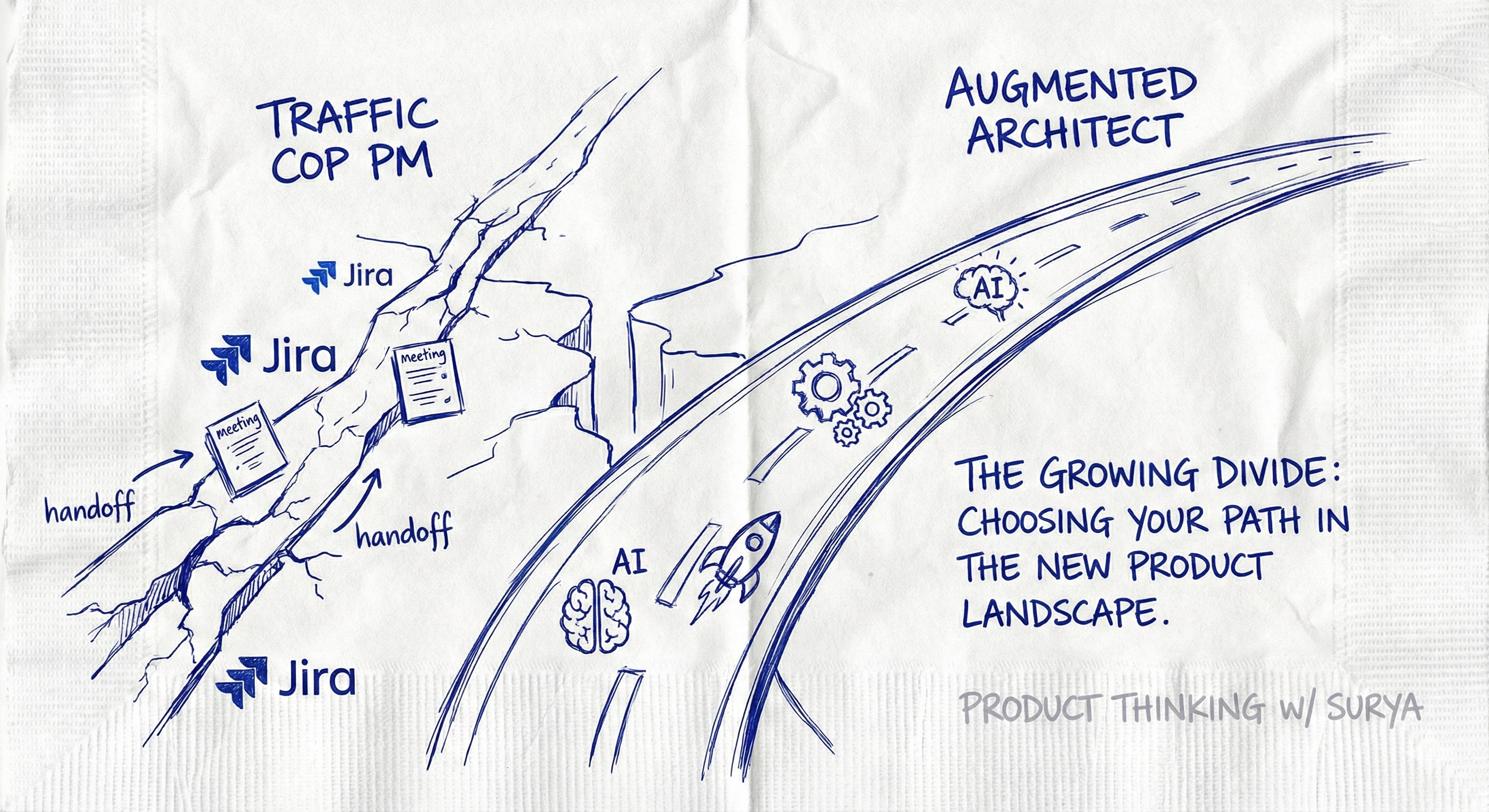
The Traffic Cop PM: Their week is a blur of meetings. They manage dependencies, chase updates, groom backlogs, refine tickets, and present status. Their primary output is documentation and coordination. When asked about customer conversations, they sigh and promise to fit them in “next week.”
The Augmented Architect: Their week is characterized by rapid customer iteration. They build functional prototypes with AI in hours, test them with users directly, analyze patterns from session data, and present validated insights with working demos to their engineering partners. They stop at 0.5 and bring in specialists to scale to 1.0. Their time goes to deep work and strategic planning, not status meetings.
The widening gap
Two groups are emerging: Augmented Architects who use AI to validate faster, and Traffic Cops who treat AI as optional while clinging to coordination rituals.
The choice isn’t whether AI impacts product management; it’s whether you’re adopting the builder mindset today. Your organization may lack custom agents or re-architected platforms. Start with individual capabilities available now. Build prototypes. Validate faster. Demonstrate value.
But understand: your organization must invest in shared infrastructure to scale this, or individual builders hit a ceiling. The mindset shift is personal and immediate. The infrastructure shift takes sustained commitment. Both are necessary.
Those who start now, even with imperfect infrastructure, position themselves to accelerate when organizations invest. Those who wait will find themselves 12 to 18 months behind. If you’re coordinating handoffs while competition is shipping, the gap won’t be closeable.
The era of the architect
The Product Trio model, while effective for a time, has succumbed to the latency and inefficiency of its own specialized handoffs. The rise of AI has exposed the “Agile Industrial Complex” for what it became: a system that prioritizes process over customer insight, trapping product managers in a cycle of coordination rather than creation.
But this isn’t a eulogy for Product Management. It’s a call for its evolution. LinkedIn’s bold move to replace its APM program with the “Associate Product Builder” isn’t an anomaly; it’s a leading indicator. It illuminates a future where the most valuable product professionals are Augmented Architects: individuals who leverage AI to vertically integrate the talent stack.
They are not generalists. They are masters of the core PM competencies (Customer Insight, Evidence, Strategy, and Inspiration), who use Fluency in adjacent domains (enabled by AI) to reinforce and accelerate their Mastery. They are “Building to Think,” reducing the latency of validation, and owning the full creative and commercial arc of a product.
The era of the Augmented Architect isn’t coming. It’s here. The question isn’t whether you understand this shift. It’s whether you’re shipping differently this quarter than last. The choice is stark: embrace this evolution and reclaim your role as a direct creator of value, or remain a traffic cop in a system that no longer requires one.